
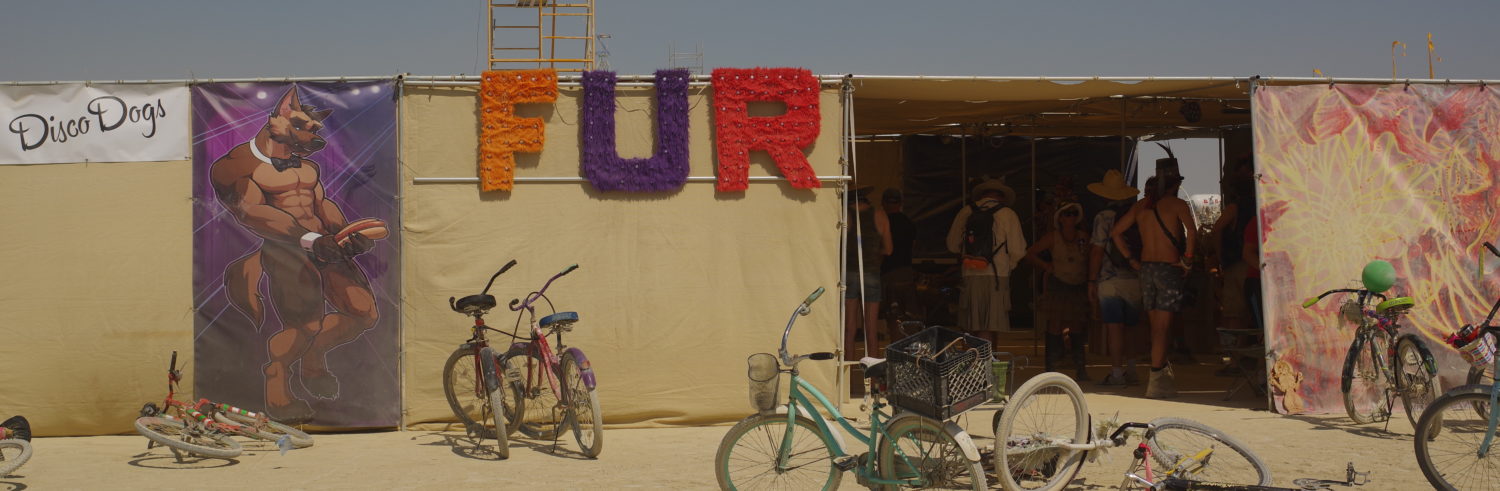
Welcome to Camp FUR! This is our “bylaws” page—really it’s just a shared set of expectations and helpful defaults so we can all have a good burn together. These bylaws were created over time to document what has worked for us in the past, and they are not a strict set of rules. The playa (and the principle of Immediacy) means we’re always adapting, learning, and changing things on the fly, and in real life we may operate more informally than this document makes us sound. We do ask everyone to read through this so we’re starting on the same page.
I. Mission and Values
Camp FUR is a Burning Man theme camp created by and for members of the furry community. Our mission is to create an inclusive, safe, and engaging space that celebrates furry identity and expression within the broader Burning Man community.
Camp started in 2010 by NeonBunny and Skibit. This was the second camp they helped found—and this time they wanted to build a camp made up of all their furry friends.
What sets Camp FUR apart from other theme camps is our core purpose: to make the playa more furry. This mission drives what we build and what we host—from the events we throw to the spaces we create, from the art we bring to the interactions we encourage. We’re here to share the joy, creativity, and community of the furry fandom with the broader Burning Man community, and ideally make the playa a more colorful, expressive, and welcoming place for everyone.
We do our best to live the Ten Principles of Burning Man, which guide how we plan, how we show up, and how we treat each other.
II. Membership and Application
Eligibility
Membership in Camp FUR is open to people who identify with or support the furry community and want to contribute positively to the camp’s mission. We welcome folks of all backgrounds, experience levels, and identities.
Application Process
We usually do a two-part application process.
Intent to Apply to Camp with FUR: This usually opens in mid-February. It helps us get a rough sense of how big camp might be this year, and it lets us collect emails so we can send the official application later.
Camp Application: This is usually sent out in late March to early April.
The application typically includes:
- Basic contact information
- A quick intro and why you want to join Camp FUR
- Skills, talents, or resources you’d like to contribute
- Your intended level of participation and commitment
- Any relevant experience with Burning Man or similar events
Member Approval
Before we finalize camp, we’ll ask everyone to read and acknowledge these bylaws so there are no surprises. By joining Camp FUR, you’re agreeing to show up in good faith, contribute where you can, and help make camp work.
III. Financial Responsibilities
Camp Dues
To cover shared camp costs, we ask all members to chip in camp dues. Dues go toward communal expenses like:
- Infrastructure and camp setup materials
- Shared resources (power, shade structures, etc.)
- Common area supplies and amenities
- A small emergency buffer for unexpected expenses
Dues Amount: Typically around $250-$300
Budget Transparency
We’ll share a detailed budget with camp during planning. It usually includes:
- Anticipated income (dues, fundraising, etc.)
- Projected expenses by category
- Contingency funds
- Post-event financial reconciliation
If you ever want to see the budget or understand what something was spent on, just ask. We keep records transparent and share a post-event recap.
Power System Investment Initiative (2026)
Starting in 2026, Camp FUR is beginning a multi-year push to upgrade our power system and move away from generators toward cleaner, renewable energy. The long-term goal is to replace camp generators entirely with battery + solar.
Year One Plan (2026): In year one, we plan to buy a large battery system capable of running core camp infrastructure. During the event, we’d charge it at least twice daily via a generator to keep power stable. This is our “foundation year” for the bigger renewable transition.
Year one cost: ~$5,424.01
3 Batteries. ECO-WORTHY 48V 100Ah Server Rack Battery | 5.12kWh V3 Lithium Battery | UL1973 | UL9540A | CEC — This will give us about 7.2 hours running 2000W continuously, or 2 hours if we’re running 6000W (which should last us a night if we have timers shutting off extra lights after a time). $2,549.97
1 Inverter. EG4 6K XP Off-Grid Inverter 6,000W Output | 48V 120/240V Split Phase | All-In-One Solar Inverter $1,509.00
Shipping + Tax: $565.04
Rack system to be able to transport it: — Listing this independently, as we might be able to find one used, or cheaper ~$800
Future Years: In future years, we plan to add solar panels to charge the batteries during the day, eventually eliminating the generator need.
Financial Commitment: This transition is a big investment, so we’ll be asking for additional optional donations on top of regular camp dues to fund this initiative. We’ll stay transparent about:
- The total costs of the power system investment
- How donations are being used
- Progress toward our renewable energy goals
- The timeline for completing the transition
These additional donations are totally optional (and deeply appreciated). Anyone who contributes is helping us become more sustainable and reduce our reliance on generators. Contributions will be documented and included in our financial recap.
IV. Leadership and Organization
Camp Mayor
The Camp Mayor is our main point-person with Burning Man’s Placement Team and helps keep camp operations moving. Responsibilities usually include:
- Coordinating with Burning Man organization
- Helping us stay aligned with event rules and requirements
- Facilitating communication among members
- Making time-sensitive decisions when needed
- Representing the camp to the broader Burning Man community
Leadership Structure
[Structure to be determined – examples might include:]
- Logistics and Build Lead: Coordinates transportation, setup, teardown, and infrastructure
- Interactivity Lead: Plans and coordinates public-facing activities and events
- Safety Lead: Helps us follow safety best practices and coordinate emergency procedures
- Leave No Trace Lead: Coordinates cleanup efforts and MOOP management
- Member Welfare Lead: Supports member needs and helps address concerns
Member Lead Roles
At Camp FUR, we like to think of everyone as an owner of the camp. Each member will be assigned (or choose) a lead role that matches their interests and skill level. Being a lead doesn’t mean you have to do all the work yourself—it means you’re the person helping make sure that area of camp gets handled. You can delegate, coordinate, and recruit help; you’re just the one keeping the thread.
Lead roles are assigned collaboratively between camp leadership and each member. We try to find roles that align with your interests, skills, and availability. For first-time campers, we aim for simpler roles that are easy to manage, and we can also create new roles tailored to what you’re excited about.
Examples of lead roles we’ve had in the past:
- Organizing a specific camp event or activity
- Building an art project for the camp
- Organizing and managing the camp bar
- Managing the communal kitchen area
- Being in charge of lighting and decor for public areas
The goal here is simple: spread responsibility around so no one person is overwhelmed, and everyone feels invested in making camp awesome. If you’re struggling with your lead role or need support, reach out—leadership and fellow campers will help.
Decision-Making
We try to make major decisions together during planning meetings, with input from everyone who wants to weigh in. If something needs immediate action, the Camp Mayor may make a quick call—then we’ll communicate it to camp as soon as we reasonably can.
Meetings
We’ll hold planning meetings leading up to the event. The exact schedule changes year to year, but it typically includes:
[Schedule to come – should be about once a month on a regular basis]
We strongly encourage folks to join meetings when they can. If you can’t make it, please read the notes and chime in asynchronously.
Communication
Good communication makes camp life easier. We use different tools depending on what we’re doing and how urgent it is.
Planning Communication – Email List
For pre-event planning, Camp FUR uses an email list as our primary communication method. Email works well for planning because:
- Asynchronous Communication: Members can participate across time zones and schedules
- Documentation: Important decisions and info are archived and searchable
- Reduced Noise: Threads tend to be more organized than chat
- Accessibility: Email is universal and doesn’t require a specific app
- Inclusivity: People who can’t do real-time chat can still participate fully
We ask members to check the email list regularly and reply when something needs a response. It’s how we keep everyone in the loop without relying on who happens to be online.
V. Planning and Preparation
Pre-Event Planning Timeline
- Early Planning (Late Feb-March): Initial organization, leadership selection, budget planning
- Mid-Planning (April-July): Infrastructure design, activity planning, member coordination
- Late Planning (August): Final logistics, packing lists, arrival coordination
Statement of Intent (SOI)
The camp will submit a Statement of Intent to Burning Man’s Placement Team by the deadline. This is needed for placement and access to Stewards Sale tickets. We’ll keep everyone posted on requirements and timing each year.
Placed Camp Questionnaire
We’ll complete the Placed Camp Questionnaire when it’s due. It covers camp layout, interactivity plans, and infrastructure, and it helps Placement understand what we’re bringing and doing.
Infrastructure Planning
Infrastructure planning usually includes:
- Layout Design: Efficient use of space balancing public interactivity and private member areas
- Shade Structures: Protection from sun and elements
- Power Systems: See the Power System Investment Initiative in Section III for our renewable transition details
- Leave No Trace: Trash, recycling, and MOOP prevention planning
- Safety Equipment: Fire extinguishers, first aid supplies, emergency communication
We hope everyone contributes to planning discussions, and folks may be asked to take on specific planning tasks based on interest and skills.
Interactivity Planning
Camp FUR loves creating interactive experiences for the Burning Man community. That usually includes both scheduled events and “walk-up” spaces that invite participation.
Camp Events: Members are encouraged to propose and organize camp events that fit our furry theme and Burning Man’s principles. Event planning usually includes:
- Developing event concepts and formats
- Scheduling events throughout the week
- Coordinating resources and materials needed
- Assigning event leads and support teams
- Promoting events to the broader Burning Man community
- Making sure events are inclusive and welcoming
We’ll talk event proposals during planning, and folks organizing events will coordinate with the Interactivity Lead for scheduling and resources. Events can be anything from workshops and performances to social hangs and creative chaos.
Interactive Spaces: Beyond scheduled events, we like to build interactive areas in camp that encourage spontaneous connection. These might include:
- Public areas designed for social interaction and connection
- Art installations that encourage participation
- Comfortable spaces for rest and conversation
- Creative spaces for impromptu activities
- [Additional interactive space concepts to be determined]
These spaces come together through planning, with members taking lead roles in different areas. Ideally they’re welcoming, safe, and aligned with our mission and the Ten Principles.
Interactivity planning needs to be reflected in our Placed Camp Questionnaire submission, since what we offer the city is a big part of placement.
Resource Coordination
We’ll coordinate shared resources (space allocation, equipment, supplies) so things feel fair and work smoothly. Please communicate your needs and what you can offer during planning.
VI. Camp Infrastructure and Setup
Arrival and Setup
Early Arrival – Core Build Team: Early arrival is generally limited to folks on the core build team and anyone with roles directly tied to building core infrastructure. The core build team typically arrives 3-5 days before gates open to get the essentials up.
Early arrival work usually focuses on:
- Establishing the basic camp layout and boundaries
- Main shared infrastructure setup
- Core shade structures and framework
- Power grid layout and installation
- Setting up essential systems other members will depend on
Core build team members will be identified during planning, and early arrival passes will be coordinated as needed. If you’re not on the core build team, please plan to arrive when gates open.
General Setup – All Members: Once you arrive, we ask everyone to help with setup. For folks arriving at gate, that often looks like:
- Unloading and organizing personal equipment
- Setting up personal camping spaces
- Assisting with final infrastructure and decor
- Setting up common areas and interactive spaces
- Testing systems (power, etc.)
- Getting public spaces and event areas ready to go
Specific roles and schedules may be shared prior to arrival. The more we coordinate arrival times, the smoother setup tends to go.
Camp Layout
Camp is typically split into three areas: persona, public and private.
Personal
This is your own personal space. Your tent, your vehicle, your shade structure, the space immediately surrounding your tent, your personal gray water evap. This is personal space that no one should be using except you, and guests should be invited in by only you.
Private
This contains the camping area for campers, including a shade area for tents, space for campers and other vehicles, a fuel storage area, and personal bike parking. In general, this is a camper-only area.
Public
The public area includes the pavilion, public bike parking, and other interactive elements. This is the area available for the public to visit.
VII. On-Playa Operations
Daily Operations and Shift Commitments
During the event, we typically run a shift board for camp duties so the workload is shared. Shifts may include:
- Greeting visitors and maintaining common areas
- Supporting scheduled camp activities and events
- Managing interactive spaces
- General camp maintenance and support
- [Additional shift types to be determined based on camp needs]
Shift needs vary by year. We’ll set expectations based on camp needs and member availability, and we ask everyone to communicate limitations early so we can build a workable schedule.
Public Engagement
We encourage members to engage with visitors in a welcoming way and help keep the camp vibe friendly and fun. That includes supporting the interactive experiences and events we planned (see Interactivity Planning in Section V).
Personal Responsibilities
Camp FUR provides shared infrastructure and communal spaces, but each member is responsible for their own basic needs during the event. Camp duties are separate from personal self-reliance.
Food and Water: Camp FUR does not have a meal plan. Each member is responsible for bringing and managing their own food and water for the duration of the event. The playa is harsh—please plan well for nutrition and hydration.
We do have a communal kitchen space where you can prep food. Please be respectful of shared space and clean up after yourself.
Hygiene: Camp FUR does not provide camp showers. We encourage good hygiene, but how you do it is up to you. Options include portable shower setups with proper gray water handling, wipes, or using public facilities elsewhere on playa.
Personal Camping Gear: Each member is responsible for bringing their own personal camping gear (shelter, bedding, etc.) and whatever you need to be comfortable and safe.
VIII. Safety and Compliance
Health and Safety
For everyone’s safety, we all follow basic health and safety practices. Some of these are Burning Man requirements, and some are just “what keeps camp from catching on fire.”
Fuel Storage:
- Comply with Burning Man regulations limiting storage to no more than 110 gallons (or two 55-gallon drums) at any time
- This does not include fuel in generators that comply with safety radius requirements
- Proper containment and safety measures must be maintained
Food Service (if applicable):
- If providing food to the public, a temporary food service permit must be obtained from the Central Nevada Health District
- All food handlers should follow health and safety protocols
- [Additional food safety requirements to be determined]
Fire Safety:
- Maintain appropriate fire extinguishers and fire safety equipment
- Adhere to open flame regulations
- [Additional fire safety protocols to be determined]
Medical and Emergency:
- [Emergency procedures to be determined]
- [First aid supplies and training to be determined]
- [Emergency contact information and protocols to be determined]
- [Evacuation plans to be determined]
- [Communication protocols during emergencies to be determined]
Compliance with Burning Man Policies
We will comply with Burning Man policies and regulations, including:
- Sound policies and quiet hours
- Vehicle use and parking regulations
- Fire safety requirements
- Placement guidelines
- Any other applicable rules and regulations
We expect all members to understand and follow these policies—both for our placement standing and for everyone’s safety.
IX. Code of Conduct
Respect and Inclusion
Camp FUR aims to be a safe, inclusive, and welcoming space. We ask all members to:
- Treat each other and all Burning Man participants with respect and dignity
- Help foster an environment free from discrimination, harassment, or disrespectful behavior
- Welcome diverse perspectives and identities
- Support each other’s well-being and safety
Consent
Consent is paramount in all interactions. We expect members to:
- Seek explicit consent before physical interaction
- Respect boundaries and personal space
- Ask before photographing or recording others
- Remember that consent can be withdrawn at any time
Substance Use
We’re not here to police anyone, but we do want everyone to be safe. We expect members to:
- Follow all applicable local, state, and federal laws regarding substance use
- Follow Burning Man policies regarding substance use
- Make responsible decisions about their own consumption
- Not pressure others to consume substances
- Support members who may need assistance
Conflict Resolution
If conflicts happen (and they sometimes do), we prefer to address them early and respectfully. Ideally the process looks like:
- Direct communication between parties when possible
- Involvement of camp leadership for mediation if needed
Camp leadership is available to help mediate and make sure everyone feels heard.
X. Leave No Trace
MOOP Management
Every camper is responsible for Leave No Trace and keeping MOOP (Matter Out Of Place) under control. That includes:
- Picking up any trash or debris immediately
- Securing loose items that could become MOOP
- Being mindful of small items (cigarette butts, bottle caps, etc.)
- Preventing items from blowing away in wind
Daily Cleanup
We’ll coordinate daily cleanup so camp stays tidy and we don’t end up with a MOOP crisis at the end. We ask everyone to participate in:
- Regular MOOP sweeps of camp areas
- Keeping personal spaces clean
- Managing waste properly
Final Cleanup and Teardown
At the end of the burn, we break it down, clean it up, and pack up for next year. To make teardown efficient (and safer for everyone), we use a structured approach to breakdown and MOOPing.
The ultimate goal is to have the public camp infrastructure broken down, packed into the container, and the public areas fully de-MOOPed by the time we lose light on Sunday. Campers can stay as long as they like and are responsible for cleaning their own personal camping areas, but we really need everyone’s help with public breakdown.
Required Teardown Shifts: We run two different optional shifts (everyone picks one), plus one final shift that everyone helps with.
1. First Optional Shift – After Man Burn: Immediately after the Man burns. This shift focuses on initial teardown and cleanup work, usually late at night to avoid the heat.
2. Second Optional Shift – Early Morning: Starting around 9am and continuing until it’s too hot. This continues teardown during the cooler morning hours.
3. Mandatory Shift – Late Afternoon: We start when it’s cool enough. This includes loading the shipping container and doing a final MOOP sweep of the entire camp area. With all hands on deck, this should be quick (usually a couple hours). You won’t miss the Temple burn.
Why This Schedule:
This structure exists for a few practical reasons:
Flexibility: People who need to leave Sunday night can do an earlier shift, and those staying Monday won’t be stuck doing everything alone
Health and Safety: We can’t risk people doing heavy labor in peak heat on Sunday—splitting shifts gives people real rest time
Efficiency: Staggered shifts keep progress moving while letting people participate around their departure plans
Teardown Responsibilities:
- Complete disassembly of all structures
- Packing and organizing all equipment
- Loading the shipping container
- Systematic MOOP sweep of entire camp area
- Checking for any remaining debris or MOOP
- Ensuring area is cleaner than when we arrived
XI. Post-Event Responsibilities
Debrief Meeting
After the event, we’ll run a debrief survey and/or meeting within a few weeks after the event. The debrief usually includes:
- What worked well
- What didn’t work so well
- Feedback on camp operations
- Ideas for improvements
Financial Reconciliation
We’ll share a transparent financial report after the event detailing:
- Total income (dues, fundraising, etc.)
- All expenses by category
- Remaining funds and their allocation
- [Additional financial details to be determined]
The financial report will be shared shortly after the event.
Website Documentation and Role Reviews
Camp FUR keeps a page on the camp website that documents major camp projects and roles. The goal is to make it easier for future campers to understand what roles exist, what projects we maintain, and what responsibilities tend to come with each role.
The website includes info about major camp projects and infrastructure such as:
- The scaffold tower
- The kitchen area
- The Narnia Lounge
- [Additional major projects and roles to be documented]
This documentation helps new members understand the scope of camp operations and hopefully find roles that match what they’re excited to do.
Post-Burn Review Requirement:
After the event, we’ll ask each member to review the website documentation for the role they held during the burn. We hope members will:
- Review the existing documentation for their role
- Provide feedback based on their actual experience
- Help revise and update the documentation to reflect what the role actually entailed
- Share insights, challenges, and recommendations for future members taking on that role
This helps keep our documentation accurate and useful, and it helps us keep improving year after year.
These bylaws are a living document and will evolve as Camp FUR grows and learns. They’re meant to give us a clear starting point while still leaving room for flexibility, spontaneity, and the wonderfully weird realities of the playa.